Enter keywords to search across articles, resources, research, events and more.
Understanding pressure across a complex system
Modelling how delays build across emergency department pathways for people with mental health and alcohol and other drug concerns
For people presenting to an emergency department with mental health or alcohol and other drug concerns, the number of people seeking care, available staffing, assessment processes and system capacity all affect their journey and experience of care.
During 2025–26, an innovative partnership between the Collaborative Centre, the University of Melbourne and the Royal Melbourne Hospital advanced the use of a state-of-the-art technique, known as ‘agent-based modelling’. This provides a bird’s eye view of consumer journeys through the mental health system from their point of entry to paths of recovery, allowing us to identify pressure points and bottlenecks, and test better ways to deliver care.
Creating a virtual environment showing pathways of care
In partnership with the Consortium, the Collaborative Centre is supporting the lead investigator of this work, Dr Belinda Davey, who is a Research Fellow at the University of Melbourne and an Honorary Research Fellow at the Royal Melbourne Hospital. With the broader research team, she is using NetLogo modelling software to create a virtual environment that represents people accessing care and the staff supporting them.
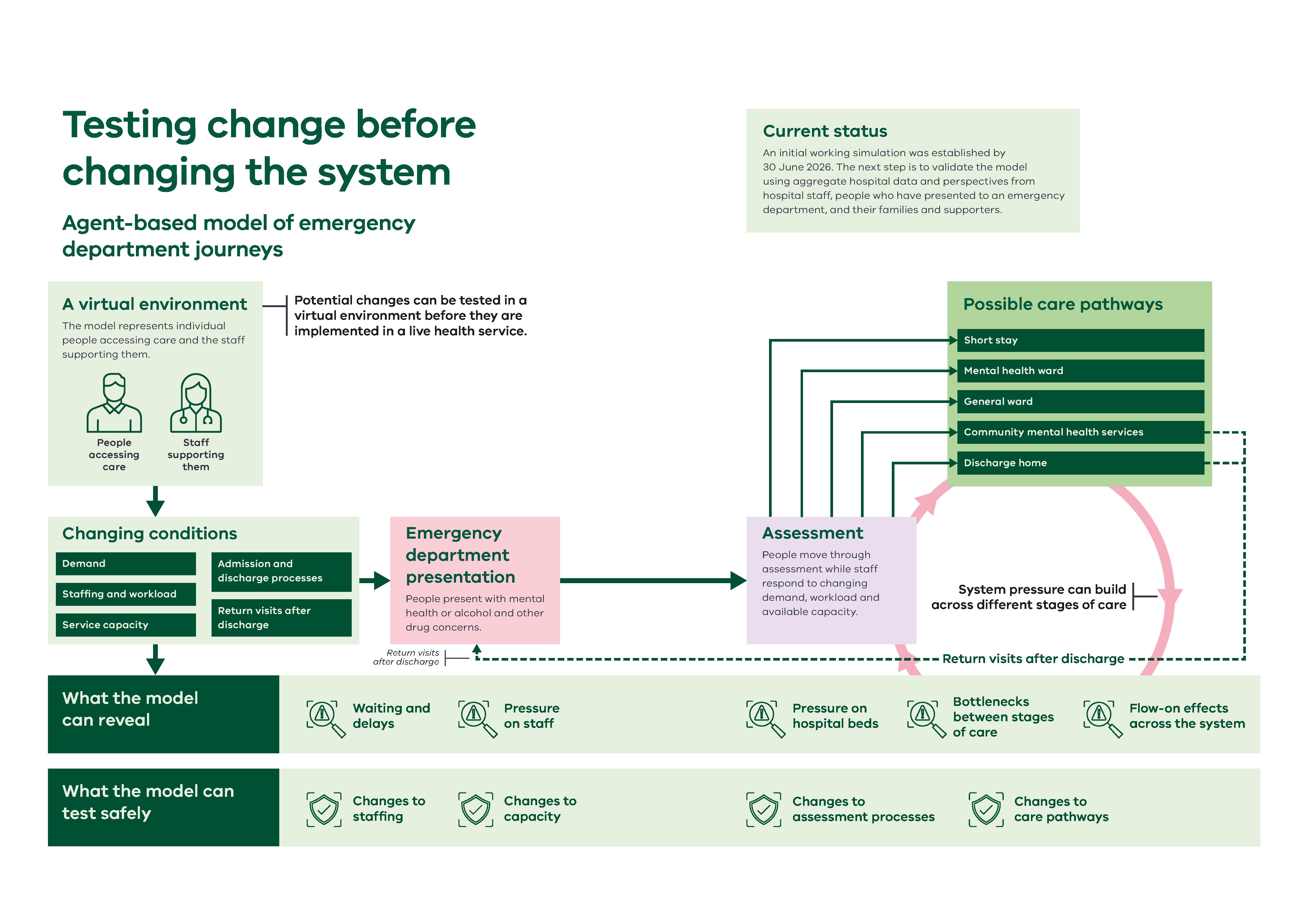
The model follows people from presentation and assessment through pathways that include short stay, mental health or general wards, community mental health services or discharge home. It represents changing demand, staffing, capacity, admission and discharge processes, and return visits after discharge.
The team can use this model to examine how and where bottlenecks form, and how interactions between different parts of the system lead to different outcomes.
By following individual journeys alongside changing demand and available resources, the simulation shows where delays begin and how they build across different stages of care to create pressure on hospital beds. This reveals patterns occurring across the system that are not evident from examining individual measures alone.
From a working model to testing change
By 30 June 2026, the team had established an initial working model informed by Royal Melbourne Hospital operating procedures and consultation with staff with expertise in mental health, service-user flow and digital coordination.
This work formed part of a broader program examining consumer journeys across Victoria’s mental health and wellbeing system. An initial conceptual model developed through the related Consumer Journey Mapping project was presented at Reform in Practice, where feedback from sector stakeholders, including people with Lived and Living Experience, informed its ongoing refinement.
The next step for the emergency department model is to validate how accurately it represents what happens in practice. The team plans to draw on aggregate hospital data and perspectives from hospital staff, people who have presented to an emergency department with mental health or alcohol and other drug concerns, and their families and supporters.
Our impact: A safe place to ask ‘what if?’
Validating the working model allows us to test potential changes to the system in a safe, ‘in silico’ environment. Once the pressure points and bottlenecks are identified, we can test changes to staffing, capacity, assessments or care pathways before they are implemented in a live health service.
The impact of this model is understanding and addressing delays, and anticipating if improvements in one part of the system will create unforeseen difficulties in another. This allows us to identify the best solutions for improving consumer and carer experiences across the mental health and wellbeing system.
Dr Belinda Davey observes that, ‘The value of the model is that we can experiment safely: testing changes, anticipating unintended consequences and identifying what is most likely to help.’
The team plans to seek funding to extend the model beyond the hospital to include community services and private practitioners, providing the Collaborative Centre with a more complete view of Victoria’s mental health and wellbeing system.
We are building a new way to test system change. Figure 3 demonstrates how the agent- based model of emergency department, mental health and alcohol and other drugs pathways, used to test how changes in demand, capacity and follow up, may affect system pressure and care pathways.
Figure 1: Testing change before changing the system. An agent-based model of emergency department journeys.